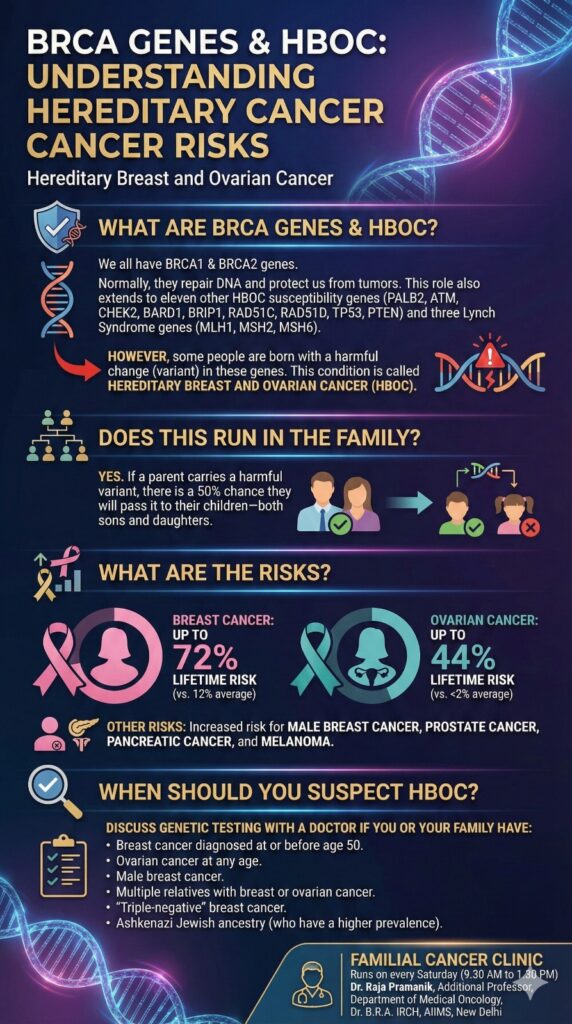
Infographics
AIIMS_Launches_Precision_Prevention_Registry
वंशानुगत_कैंसर_टेस्टिंग_एम्स_की_रजिस्ट्री
Educational Content
Myths and Facts related to Cancer
There are several common myths surrounding genetic cancers, particularly those related to the breast, ovary, and colon, which often involve hereditary gene mutations like those in BRCA1/2 or Lynch syndrome genes. Here are some of the most common myths, followed by the facts:
❌ Myth 1: Only women can inherit or pass on gene mutations like BRCA.
✅ Fact:
- Both men and women can carry and inherit the gene mutations (like BRCA1, BRCA2, or those for Lynch Syndrome) that increase cancer risk.
- A mutation can be passed down from either the mother or the father to their children, regardless of the child’s sex. There is a 50% chance of passing the mutation to each child.
- Men who inherit a BRCA mutation have an increased risk of developing cancers like male breast cancer, prostate cancer, and pancreatic cancer.
❌ Myth 2: If there's no cancer in my family, I don't need to worry about genetic cancer risk.
✅ Fact:
- Most cancers—about 90-95%—are not hereditary. They are considered sporadic, caused by lifestyle, environmental factors, or the normal aging process.
- A genetic mutation might be present in your family, but the cancer could have “skipped” a generation because not everyone with the mutation develops cancer.
- Even without a known family history, a new mutation can sometimes occur, or family history may simply be incomplete or unknown.
❌ Myth 3: If I have a cancer-related gene mutation, I am guaranteed to get cancer.
✅ Fact:
- Inheriting a gene mutation, like BRCA1 or a Lynch Syndrome gene, means you have a significantly higher lifetime risk of developing certain cancers compared to the general population.
- However, it is not a guarantee (or “death sentence”) you will get cancer.
- The actual risk varies based on the specific gene mutation, your sex, family history, and other factors. Knowing you have a mutation allows you to take proactive steps (like increased screening, risk-reducing medications, or preventative surgery) to manage and drastically reduce that risk.
❌ Myth 4: Only a family history of breast cancer is important; other cancers don't count.
✅ Fact:
- Multiple cancers can be linked to the same gene mutation. For example:
- BRCA1/2 mutations increase the risk for breast, ovarian, prostate, and pancreatic cancers.
- Lynch syndrome mutations significantly increase the risk for colon, endometrial (uterine), ovarian, and several other cancers.
- When evaluating your hereditary risk, your doctor or genetic counselor will look at the entire pattern of cancer on both sides of your family, including different cancer types and the ages at which they occurred.
❌ Myth 5: Genetic testing is pointless if I already have cancer.
✅ Fact:
- Genetic testing is still highly valuable after a cancer diagnosis. The results can:
- Guide Treatment: Certain gene mutations (like BRCA) make some cancer treatments (like specific chemotherapies or targeted therapies) more effective.
- Identify Other Risks: It can indicate an increased risk for a second primary cancer (e.g., a woman with breast cancer and a BRCA mutation may be at high risk for ovarian cancer).
- Inform Relatives: A positive result can inform your family members that they may also carry the mutation and should consider testing and early screening.
❌ Myth 6: If my genetic test result is negative, I don't have to worry about cancer at all.
✅ Fact:
- A negative test result for a known hereditary mutation (like BRCA1/2 or Lynch syndrome genes) does not mean you are immune to cancer.
- Most cancers (90-95%) are still sporadic. You still have the same risk as the general population for cancers caused by aging, lifestyle, or environmental factors.
- You must still follow age-appropriate, standard screening guidelines (e.g., routine mammograms for breast cancer, colonoscopies for colon cancer, etc.).
❌ Myth 7: Genetic testing is only useful for people of Ashkenazi Jewish descent.
✅ Fact:
- While BRCA mutations are more prevalent in the Ashkenazi Jewish population (about 1 in 40 carry a founder mutation), BRCA and other hereditary cancer mutations occur in people of all races and ethnicities.
- The vast majority of people who receive genetic testing are not of Ashkenazi Jewish descent.
- Anyone with a concerning family or personal history of early-onset, aggressive, or multiple related cancers should be evaluated for genetic testing, regardless of their background.
❌ Myth 8: Genetic testing is too expensive and is never covered by insurance.
✅ Fact:
- The cost of genetic testing has dropped dramatically in recent years.
- Most insurance providers will cover the cost of genetic counseling and testing if you meet specific medical guidelines (like the criteria set by the National Comprehensive Cancer Network, NCCN).
- These guidelines are typically met if you have an early-onset cancer diagnosis, multiple family members with related cancers, or a known mutation in the family. For those who don’t meet criteria, many labs offer self-pay options for a much lower cost than in the past.
❌ Myth 9: If I have a gene mutation, my lifestyle choices don't matter anymore.
✅ Fact:
- Lifestyle still matters significantly! Having a high-risk gene mutation is just one factor in your overall cancer risk.
- Healthy habits can still help mitigate your risk:
- Maintaining a healthy weight
- Regular physical activity
- Limiting alcohol consumption
- Avoiding smoking
- While a mutation increases the baseline risk, these positive choices can influence your overall health and the penetrance (likelihood) of the cancer developing.
Reducing Sporadic Cancer Risk: Diet & Lifestyle
The diet and lifestyle modifications are the primary way to influence the risk of Sporadic cancer (the 90-95%). This helps empower all visitors, regardless of their genetic test results. Sporadic cancer is when cancer occurs by chance, without a strong inherited genetic link. Scientific consensus shows that a large percentage of these cancers can be prevented through lifestyle choices.
1. Maintain a Healthy Weight
Maintaining a healthy body weight is one of the most effective ways to lower the risk of many cancers, including breast, colon, and ovarian cancer. Excess body fat can change hormone levels (like estrogen, which is linked to breast and ovarian cancer) and cause chronic inflammation.
2. Emphasize a Plant-Forward Diet
The American Cancer Society (ACS) recommends a diet with an emphasis on plant-based foods. Aim for two-thirds of your plate to be vegetables, fruits, and whole grains.
- Fruits and Vegetables: Aim for at least 2 1/2 cups daily. Focus on non-starchy vegetables and a variety of colors (the “Eat the Rainbow” concept).
- Whole Grains: Choose brown rice, quinoa, oats, and whole-wheat bread over refined grains. Whole grains are rich in fiber, which is strongly linked to a reduced risk of colorectal cancer.
- Beans and Legumes: Excellent sources of fiber and plant protein (e.g., lentils, chickpeas, black beans).
3. Limit or Avoid High-Risk Foods
- Processed and Red Meat (Colon Cancer Focus):
- Limit: Red meats (beef, pork, lamb).
- Avoid: Processed meats (bacon, sausages, hot dogs, deli slices), which are strongly linked to an increased risk of colorectal cancer.
- Choose Leaner Alternatives: Opt for poultry, fish, or plant-based proteins (beans, tofu, nuts).
- Sugar-Sweetened Drinks and Processed Foods (Weight Management):
- These foods are often high in calories and contribute to weight gain, which is an independent risk factor for several cancers. Focus on whole, minimally processed foods.
4. Limit Alcohol Consumption (Breast & Colon Cancer Focus)
- Alcohol consumption is linked to an increased risk of several cancers, including breast and colon cancer.
- Recommendation: If you choose to drink, limit intake to no more than one drink per day for women and two drinks per day for men. Eliminating alcohol entirely provides the greatest benefit for cancer risk reduction.
5. Increase Fiber Intake (Colon Cancer Focus)
- Focus: Dietary fiber helps move food and waste through the digestive system faster, reducing the contact time between the colon lining and potential carcinogens.
- Sources: Whole grains, fruits, vegetables, nuts, seeds, and legumes. Aim for 30 grams of fiber daily.
6. Physical Activity Recommendations
- Aerobic Activity: Aim for at least 150 minutes of moderate-intensity activity per week (e.g., brisk walking, cycling, gardening) OR 75 minutes of vigorous-intensity activity per week (e.g., jogging, swimming laps, circuit training).
- Muscle-Strengthening Activity: Include activities that work all major muscle groups (legs, hips, back, abdomen, chest, shoulders, and arms) at least two days a week. (e.g., lifting weights, bodyweight exercises, using resistance bands).
7. Minimize Sedentary Behavior
- The Problem with Sitting: Spending too much time sitting (sedentary behavior) is now considered an independent risk factor for several diseases, even if you meet the weekly exercise goals.
- The Solution: Encourage visitors to “Sit Less, Move More.” Take short breaks every 30-60 minutes to stand, stretch, or walk around while working or watching TV.
जेनेटिक (आनुवंशिक) कैंसर से जुड़े 10 प्रमुख भ्रम और उनके पीछे के सच
भ्रम 1: केवल महिलाएं ही BRCA जैसे जीन म्यूटेशन को आगे बढ़ा सकती हैं।
सच: महिलाएं और पुरुष दोनों इन म्यूटेशन के वाहक हो सकते हैं और इन्हें अपने बच्चों में पास कर सकते हैं। पिता की तरफ से भी यह जोखिम उतना ही आता है जितना माता की तरफ से।
भ्रम 2: अगर मेरे परिवार में किसी को कैंसर नहीं है, तो मुझे चिंता करने की ज़रूरत नहीं है।
सच: अधिकांश कैंसर आनुवंशिक नहीं होते, लेकिन कभी–कभी जीन म्यूटेशन परिवार में मौजूद होता है और वह किसी पीढ़ी को “छोड़” (skip) देता है। साथ ही, कैंसर का पारिवारिक इतिहास अधूरा या अज्ञात भी हो सकता है।
भ्रम 3: अगर मेरे पास कैंसर से संबंधित जीन म्यूटेशन है, तो मुझे कैंसर होना तय है।
सच: म्यूटेशन का मतलब है कि आपका जोखिम (Risk) अधिक है, लेकिन यह कैंसर होने की गारंटी नहीं है। जानकारी होने से आप समय से पहले सावधानी और बचाव के उपाय कर सकते हैं।
भ्रम 4: केवल स्तन कैंसर का पारिवारिक इतिहास ही मायने रखता है।
सच: एक ही जीन म्यूटेशन कई तरह के कैंसर से जुड़ा हो सकता है। जैसे BRCA म्यूटेशन से अग्नाशय और प्रोस्टेट कैंसर का खतरा भी जुड़ा है, और लिंच सिंड्रोम से कोलन और गर्भाशय के कैंसर का।
भ्रम 5: कैंसर होने के बाद जेनेटिक टेस्ट कराना बेकार है।
सच: टेस्ट के नतीजे डॉक्टर को सही इलाज चुनने में मदद करते हैं। साथ ही, इससे यह पता चलता है कि क्या आपको भविष्य में किसी दूसरे प्रकार के कैंसर का खतरा तो नहीं है।
भ्रम 6: अगर मेरा जेनेटिक टेस्ट नेगेटिव आता है, तो मुझे कैंसर की चिंता करने की ज़रूरत नहीं है।
सच: नेगेटिव रिजल्ट का मतलब है कि आपमें वो खास ‘आनुवंशिक‘ खतरा नहीं है। लेकिन आपको अभी भी सामान्य कैंसर
का उतना ही खतरा है जितना किसी भी आम व्यक्ति को होता है। इसलिए नियमित स्क्रीनिंग (जैसे मैमोग्राम) ज़रूरी है।
भ्रम 7: जेनेटिक टेस्टिंग केवल कुछ खास समुदायों (जैसे अश्केनाज़ी यहूदी) के लिए है।
सच: हालांकि कुछ जातियों में कुछ म्यूटेशन अधिक पाए जाते हैं, लेकिन जेनेटिक कैंसर म्यूटेशन किसी भी नस्ल, जाति या समुदाय के व्यक्ति में हो सकते हैं।
भ्रम 8: जेनेटिक टेस्टिंग बहुत महंगी है और इंश्योरेंस इसे कवर नहीं करता।
सच: पिछले कुछ वर्षों में इन टेस्ट की कीमतों में भारी कमी आई है। यदि आपके परिवार में कैंसर का इतिहास है, तो अधिकांश बीमा कंपनियां (Medical Insurance) डॉक्टर की सलाह पर इसका खर्च उठाती हैं।
भ्रम 9: जेनेटिक टेस्ट के नतीजों का इस्तेमाल मेरी नौकरी या इंश्योरेंस के खिलाफ भेदभाव के लिए किया जा सकता है।
सच: अमेरिका जैसे कई देशों में (GINA कानून के तहत) स्वास्थ्य बीमा कंपनियों और नियोक्ताओं (Employers) के लिए जेनेटिक जानकारी के आधार पर भेदभाव करना गैरकानूनी है। भारत में भी बीमा नियामक (IRDAI) इस दिशा में सुरक्षा प्रदान करता है।
भ्रम 10: अगर मुझमें जीन म्यूटेशन है, तो मेरी जीवनशैली (Lifestyle) का अब कोई महत्व नहीं है।
सच: जीवनशैली अभी भी बहुत मायने रखती है। अच्छा खान–पान, नियमित व्यायाम और शराब/धूम्रपान से दूरी कैंसर के खतरे को कम करने या उसे देरी से होने में मदद कर सकती है।
Ovarian Cancer Awareness